
Categories
Tips for HomeownersPublished June 22, 2026
Your 2026 Georgia Property Assessment Is Out. Here Is What North Atlanta Homeowners Need to Know Before the Deadline.

PROPERTY TAX ALERT — 2026 TAX YEAR
Your 2026 Georgia Property Assessment Is Out. Here Is What North Atlanta Homeowners Need to Know Before the Deadline.
By Rana Tayara, REALTOR® | Published June 22, 2026 | North Atlanta: Roswell, Alpharetta, Milton, Johns Creek, Sandy Springs, Dunwoody, Cumming, Brookhaven & East Cobb
| TIME-SENSITIVE: GWINNETT COUNTY DEADLINE IS JUNE 29, 2026 If you own property in Gwinnett County, you have seven days to file an appeal. There are no extensions under Georgia law. See the county deadline table below. |
A letter arrived in your mailbox from your county tax assessor. It looks official and a little alarming. Before you set it aside, know this: it may be the most actionable document you receive all year.
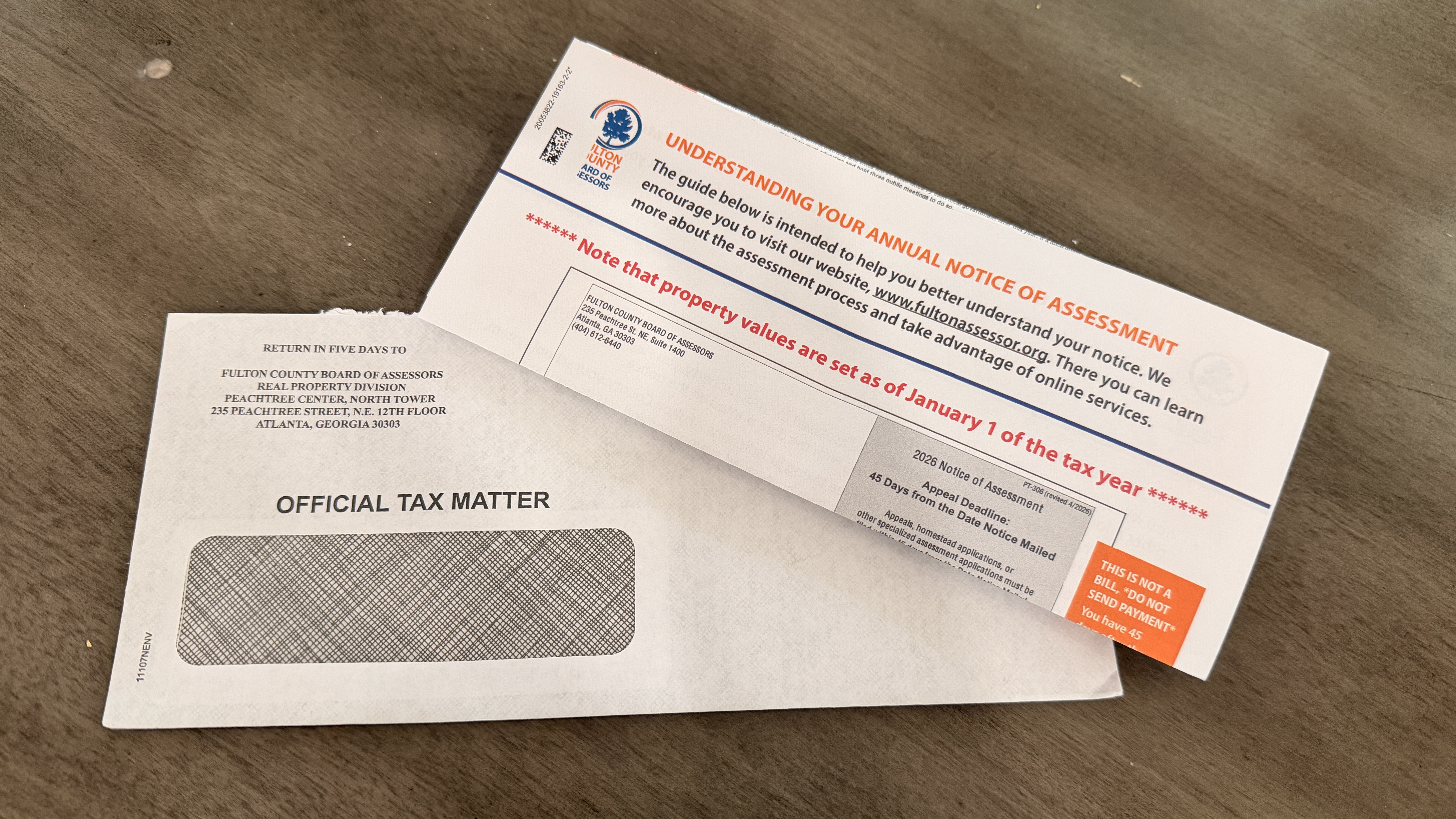
That letter is your 2026 Notice of Assessment: not a tax bill, but the county’s official estimate of your home’s value as of January 1, 2026. That number is the starting point for every property tax dollar you will pay this fall. And if it is too high, you have the right to challenge it. You just have to move quickly.
Across North Atlanta, six counties have already mailed their 2026 assessments. Appeal windows are already open and already closing. If you are a homeowner in Fulton, Cobb, Gwinnett, DeKalb, Cherokee, or Forsyth County, this guide is for you.
| 45 days from notice date to appeal. NO exceptions |
60%+ of metro Atlanta residential appeals result in a reduction |
3 Tax years your reduced value is locked in after a successful appeal |
40% of fair market value is your Georgia assessed value |
What Is a Notice of Assessment — and Why Does It Matter?
Every year, Georgia county tax assessors are required by law to notify property owners of their home’s estimated fair market value as of January 1. This notification is the Notice of Assessment. It is not a tax bill. It is the foundational number from which your entire tax bill is calculated.
Here is how Georgia’s property tax calculation works:
| GEORGIA PROPERTY TAX FORMULA Step 1: County estimates your home’s fair market value (FMV). Step 2: Assessed value = FMV × 40% (required by Georgia law, O.C.G.A. § 48-5-7) Step 3: Taxable value = Assessed value − Exemptions (homestead, senior, veteran, etc.) Step 4: Tax bill = Taxable value × local millage rate Example: County values your home at $600,000 → Assessed value: $240,000 → Less standard homestead exemption ($14,000) → Taxable value: $226,000 → At a combined rate of 32 mills: approximately $7,232 per year.
|
If the county’s fair market value estimate is inflated by even $50,000, you are paying hundreds of dollars per year in unnecessary taxes. Over three years — because Georgia freezes your reduced value after a successful appeal — the overpayment compounds significantly.
The county values thousands of homes at once using mass appraisal models. They are not walking through your house. An appeal gives you the opportunity to put the actual evidence on the table.
Which North Atlanta Counties Have Released 2026 Assessment Notices?
All six major North Atlanta metro counties have mailed their 2026 Notices of Assessment. The table below shows the current status, official appeal deadlines, and assessor portal addresses for each county. The date printed on your individual notice controls your deadline — always verify it on the document itself.
| County |
Notice Mailed |
Appeal Deadline |
Days Left (as of 6/22) |
Assessor Portal |
| Gwinnett |
May 15, 2026 |
June 29, 2026 |
7 days — ACT NOW |
gwinnett-assessor.com |
| Forsyth |
May 30, 2026 |
July 14, 2026 |
22 days |
forsythco.com/Departments-Offices/Board-of-Assessors/Assessments |
| DeKalb |
May 31, 2026 |
July 15, 2026 |
23 days |
dekalbtax.com |
| Cobb |
~June 6, 2026 |
~July 21, 2026 |
~29 days |
cobbassessor.org |
| Cherokee |
June 15, 2026 |
~July 30, 2026 |
~38 days |
cherokeega.com/assessors |
| Fulton |
June 16, 2026 |
July 31, 2026 |
39 days |
fultonassessor.org |
Deadlines calculated at 45 days from official mailing dates.
Why Your 2026 Assessment May Not Reflect Your Home’s True Value
County assessors use mass appraisal models to value tens of thousands of properties simultaneously. These models analyze broad market trends, neighborhood sales, and property characteristics drawn from public records. They are efficient, but they are not precise at the individual property level.
Common reasons a 2026 assessment may be inaccurate include:
• Condition the county cannot see. Deferred maintenance, aging systems, foundation issues, or outdated finishes that reduce a home’s marketability are invisible to a mass appraisal model that has never entered your front door.
• Incorrect property data. County records sometimes carry errors in square footage, room counts, lot size, or improvement dates. Any of these can push a valuation above fair market value.
• Comparable sales that are not truly comparable. The model may pull sales from areas or price points that do not genuinely reflect your property’s submarket, neighborhood dynamics, or home characteristics.
• Rapid market shifts. In markets that have softened since the valuation date of January 1, 2026, assessments may reflect prices from a stronger period rather than current conditions.
For homeowners in Roswell, Alpharetta, Milton, Sandy Springs, Johns Creek, Dunwoody, Cumming, Brookhaven, and East Cobb, the hyperlocal dynamics of the North Atlanta corridor mean that broad county-level assumptions can miss the mark on individual properties — particularly in newer subdivisions, lake-adjacent communities, or neighborhoods with significant condition variation.
How to Appeal Your Georgia Property Tax Assessment
The appeal process in Georgia is designed to be accessible to property owners without legal representation, though professional help is available if warranted. Here is how it works:
1. Review your Notice of Assessment carefully. Confirm the county’s fair market value estimate, verify that your property details are accurate (square footage, bedroom/bathroom count, lot size, year built), and locate the appeal deadline printed on the notice.
2. Compare to recent sales in your neighborhood. Research homes similar to yours that sold in the six to twelve months prior to January 1, 2026. These comparable sales are the foundation of any successful appeal. A local REALTOR® with MLS access can pull the cleanest, most defensible comparable data for your specific property.
3. File your appeal within 45 days of the notice date. Use Georgia Form PT-311A (available at your county assessor’s website or dor.georgia.gov) or submit a written letter. Most North Atlanta counties now accept online appeals. Your appeal must specify your preferred method: Board of Tax Assessors review, Board of Equalization hearing, or arbitration.
4. Await the Board of Tax Assessors review. The county will review your filing and may offer a reduced value before a formal hearing. If the adjustment is acceptable, the case closes. If not, your appeal advances to your chosen appeal body.
5. Present your case at a Board of Equalization hearing if needed. The Board of Equalization is a panel of trained local property owners who hear evidence from both the homeowner and the county appraiser. Georgia law requires the county to provide its comparable sales and methodology within ten business days of your written request — always request this before your hearing.
| IMPORTANT: Your Tax Bill Is Not Deferred During an Appeal Filing an appeal does not delay your property tax bill, which typically arrives in August. However, Georgia law allows you to pay at 85% of the appealed value while your case is pending, reducing your immediate cash outlay. The remaining balance, if any, is due after the final appeal decision. |
The Three-Year Value Freeze: Why This Matters More Than You Think
One of the most powerful — and least understood — provisions of Georgia property tax law is the three-year value freeze. Under O.C.G.A. § 48-5-299, a successful appeal locks in your reduced assessed value not just for the current tax year, but for the two succeeding years as well.
If you win a reduction of $40,000 in assessed value in 2026, your county is bound by that lower number in 2027 and 2028, regardless of market appreciation. At a combined millage rate of 30 mills, a $40,000 reduction in assessed value saves approximately $1,200 per year, or $3,600 over the three-year freeze period — from a single filing.
The math is compelling enough that even homeowners who are unsure whether their assessment is inflated often find it worthwhile to investigate. Filing itself is free, and the worst outcome is no change.
| NEW IN 2026 — SENATE BILL 566 Missed the April 1 Homestead Exemption Deadline? You May Have Another Chance. Georgia law has historically required homeowners to apply for a homestead exemption by April 1 of each year. Missing that date meant waiting until the following year. A significant change effective for the 2026 tax year now extends that window. Under Senate Bill 566, signed into Georgia law in 2026, property owners may apply for a homestead exemption up to and including the deadline to appeal their assessment notice — which, depending on your county, falls between late June and the end of July 2026. For homeowners who purchased their primary residence in 2025 and did not know to apply, or who missed April 1 for any reason, this is a meaningful second opportunity — one that expires at the same time as the appeal window. Do not let it pass. |
What Is the Homestead Exemption — and What Does It Save?
The homestead exemption reduces the taxable assessed value of your primary residence. Georgia’s baseline exemption reduces your assessed value by $2,000 for state purposes, $10,000 for county taxes, and $4,000 for school taxes. But many North Atlanta counties offer local exemptions that go considerably further.
• Gwinnett County offers exemptions that reduce assessed value by $10,000 for county taxes, $8,000 for school taxes, and $7,000 for recreation taxes.
• Forsyth County offers a floating homestead exemption that can freeze your property’s base-year value for county maintenance and operations taxes — compounding in value every year your home appreciates.
• Cherokee County similarly offers a floating exemption that locks in your value at the time the exemption was first received.
• Seniors aged 62 and older may qualify for school tax exemptions that can save thousands annually across most North Atlanta counties.
• Qualified veterans with 100% VA disability ratings may be eligible for a full exemption on their primary residence.
| The Floating Homestead Exemption (HB 581) Starting with the 2025 tax year, Georgia’s floating homestead exemption caps the annual increase in a home’s taxable value to the prior year’s rate of inflation. If your home’s market value rises 12% but inflation was 3%, you are only taxed on the 3% increase — the rest is exempted. This protection compounds over time and becomes increasingly valuable in rising markets. Note: Cobb County has opted out of the HB 581 floating exemption. Homeowners in East Cobb should verify which exemptions apply with the Cobb County Tax Assessors’ Office. |
Your 2026 Property Assessment Action Checklist
Here is what to do if you own property in a North Atlanta county that has released its 2026 assessment:
✓ Locate your 2026 Notice of Assessment. If you have not received it by mail, check your county assessor’s online portal — notices are posted there and available to view and print.
✓ Find the appeal deadline printed on your notice. Mark it on your calendar immediately.
✓ Review the county’s fair market value estimate. Compare it to what homes similar to yours in your neighborhood actually sold for in the past twelve months.
✓ Check for errors in your property details: square footage, number of bedrooms and bathrooms, lot size, year built, and listed improvements.
✓ If you purchased your home after January 1, 2025, and did not apply for a homestead exemption by April 1 — apply now, before your assessment appeal deadline closes.
✓ If you are 62 or older or have a qualifying disability or veteran status, contact your county assessor to confirm which additional exemptions apply to you.
✓ If your assessment appears inflated, file an appeal through your county’s online portal or by mail using Form PT-311A before the 45-day window closes.
✓ If you want guidance on where to start or who to work with, reach out. I can connect you with the right resource for your county and situation.
Frequently Asked Questions
Georgia Property Tax Appeal: What Homeowners Ask Most
How long do I have to appeal my 2026 property tax assessment in Georgia?
Georgia law gives property owners exactly 45 days from the date printed on their Notice of Assessment to file a formal appeal with the county Board of Tax Assessors. This deadline is strictly enforced with no extensions or exceptions under any circumstances. The specific deadline is clearly marked on your individual notice and varies by county.
Which North Atlanta counties have released their 2026 property assessment notices?
As of June 22, 2026, all six major North Atlanta counties have mailed their 2026 Notices of Assessment: Gwinnett (mailed May 15, deadline June 29), Forsyth (mailed May 30, deadline July 14), DeKalb (mailed May 31, deadline July 15), Cobb (mailed approximately June 6, deadline approximately July 21), Cherokee (mailing began June 15, deadline approximately July 30), and Fulton (mailed June 16, deadline July 31).
Can I still apply for a homestead exemption if I missed the April 1 deadline?
Yes, starting with the 2026 tax year. Under Senate Bill 566, effective for the 2026 tax year, Georgia now allows property owners to apply for a homestead exemption up to and including the last day of their 45-day assessment appeal window. This is a significant new provision for homeowners who missed the April 1 deadline. This window closes at the same time as your appeal deadline, so act promptly.
Does a successful appeal lock in my lower value for future years?
Yes. Under Georgia law, a successful property tax appeal locks in the reduced assessed value for the current tax year plus two additional years — a three-year value freeze. This means one well-documented appeal can produce three consecutive years of lower property taxes based on the reduced valuation, compounding your savings significantly.
How is my Georgia property tax calculated?
Georgia assesses residential property at 40% of its estimated fair market value. This is your assessed value. Subtract any applicable exemptions to arrive at your taxable value. Multiply the taxable value by your local combined millage rate to determine your annual tax bill. For example, a home valued at $500,000 carries an assessed value of $200,000. Less a standard homestead exemption of roughly $14,000, the taxable value is $186,000. At 30 mills, the annual bill would be approximately $5,580.
What evidence is most effective in a Georgia property tax appeal?
The strongest evidence is recent comparable sales of genuinely similar homes within your neighborhood, sold within six to twelve months prior to January 1 of the tax year. Supplement this with photographs documenting any condition issues that reduce marketability, documentation of errors in the county’s property records, and, for high-value or unique properties, a professional appraisal. Georgia law requires the county to provide its comparable sales and appraisal methodology within ten business days of a written request — always request this before your hearing.
Is a Notice of Assessment the same as a property tax bill?
No. The Notice of Assessment is not a tax bill. It is the county’s official notification of your property’s estimated fair market value as of January 1. Your actual property tax bill is typically mailed in August and due by mid-October. Your right to appeal is triggered by the Notice of Assessment, not the tax bill, and it must be exercised within the 45-day window following the notice date.
| CONNECT WITH A NORTH ATLANTA MARKET EXPERT Not Sure If Your Assessment Is Too High? Let’s Talk. As a North Atlanta REALTOR® with 15 years of market data and deep roots across Roswell, Alpharetta, Milton, Johns Creek, Sandy Springs, Dunwoody, Cumming, and Brookhaven, I know what homes are actually selling for in your neighborhood — and I can connect you with the right professional to evaluate your assessment and represent your appeal if one is warranted. Call or text: 678-294-3838 Email: RanaTayara@kw.com This is a free conversation. No obligation. Just clarity on where you stand before your deadline closes. |
Rana Tayara, Realtor® | Real Estate Advisor
Phoenix Award- Atlanta Board of Realtors
Keller Williams Realty Consultants
Serving the North Atlanta Area
📱 Call/Text: 678.294.3838
✉️ Email: ranatayara@kw.com
🌐 Website: www.RanaTayara.com
Other Articles:
How's the Real Estate Market in North Atlanta- June
Why 65% of North Atlanta Homeowners are Leaving Money on the Table
Why Atlanta is the Nb 1 City to Start a Career
Upsizing in North Atlanta
2025 Luxury Housing Market
| This article is provided for informational purposes only and does not constitute legal or tax advice. Property tax laws and deadlines vary by county and individual notice. Always verify the specific deadline printed on your Notice of Assessment and consult a qualified property tax professional for guidance specific to your situation. |

Rana Tayara
| Rana Tayara Homes | Keller Williams Realty Consultants
or another way